
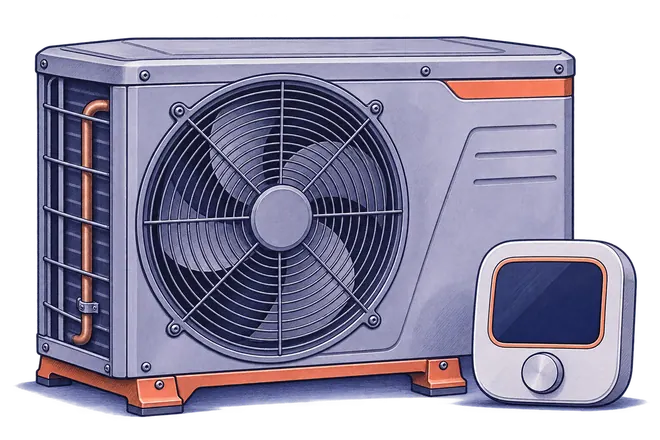
Three temperatures that explain what your system is doing
- The balance point
- The outdoor temperature at which the heat pump’s output matches the heat your home loses. Below that point, the compressor may keep running while backup heat makes up the difference. Two homes with the same model can have different balance points.
- The equipment’s operating limit
- The manufacturer publishes an outdoor operating range for each model. To find yours, use the full outdoor model number and look for the heating performance table or ask for it on a service call. That table also shows how much heat the unit can actually deliver at different temperatures.
- The thermostat’s changeover setting
- Some controls limit when the compressor or backup heat can run. A setting chosen for a particular installation can make a system switch heat sources before it reaches its physical operating limit.
The U.S. Department of Energy heat pump sizing guide (PDF) explains how heating capacity and a home’s heat loss meet at the balance point.
Will it still heat at 32°F? What about 5°F?
Crossing 32°F does not automatically switch a heat pump off. Check whether the home holds its set temperature through the cold spell. Air at a supply vent can feel cooler against your hand than furnace air while the system is still warming the home.
For an example of how much models differ, ENERGY STAR requires qualifying cold-climate heat pumps to deliver at least 70% of their rated 47°F heating capacity at 5°F. That figure applies to models with the cold-climate designation. For your own system, the useful number is its published heating output at the outdoor temperature you’re asking about.
Why AUX appears on a Florida morning
On an air-source heat pump, moisture can freeze on the outdoor coil. The unit may briefly reverse operation to clear frost. Depending on the equipment and controls, backup heat may run during defrost or after you raise the thermostat several degrees. A little steam at the outdoor unit during defrost can be normal.
For example, if you raise the setting from 65°F to 70°F at breakfast and AUX appears, note whether it clears after the house catches up. If you leave the setting steady and the indoor temperature keeps falling, that is a different symptom to report. Read the homeowner guide to heat pump operation (PDF).
What to record before a heating repair visit
- The outdoor temperature, thermostat setting and actual room temperature at the beginning and end of an hour.
- Whether the display shows Heat, AUX or Emergency Heat, and whether you recently changed the setting.
- Whether frost clears after a defrost cycle or a thick layer stays on the outdoor coil. Leave ice in place for the technician to assess.
Book a heating diagnosis if the house keeps losing temperature, the coil remains heavily iced, or backup heat runs continuously in mild weather. These details help us check airflow, defrost operation and controls without assuming the compressor has failed.